
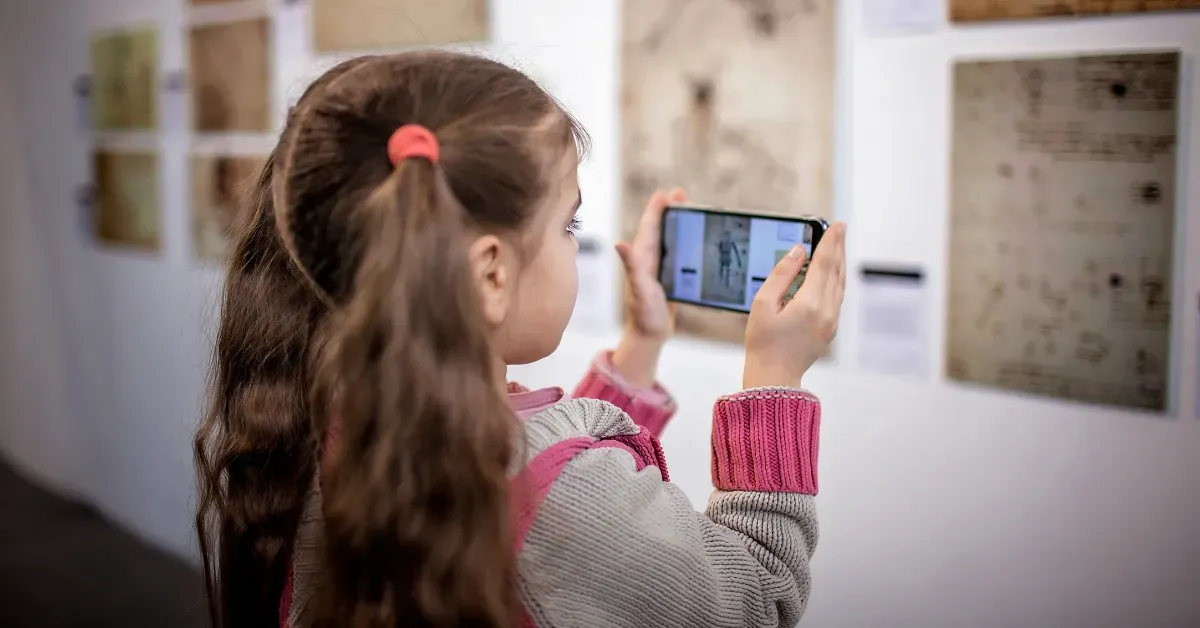
Traveller expectations have shifted. Today’s visitors arrive at heritage sites shaped by the attention economy, where digital experiences are designed to compete for and sustain attention.
Yet many historical sites still rely on traditional interpretation tools like static signs, printed brochures, and occasional guided tours.
Visitors often read, take a photo, and move on without fully engaging with the story of the place. This creates a gap between information and experience.
Augmented reality helps close that gap by turning passive interpretation into interactive, immersive storytelling.
In this article, we explore how AR is transforming heritage experiences and the different ways it is being used to bring history to life.
What Is Augmented Reality?
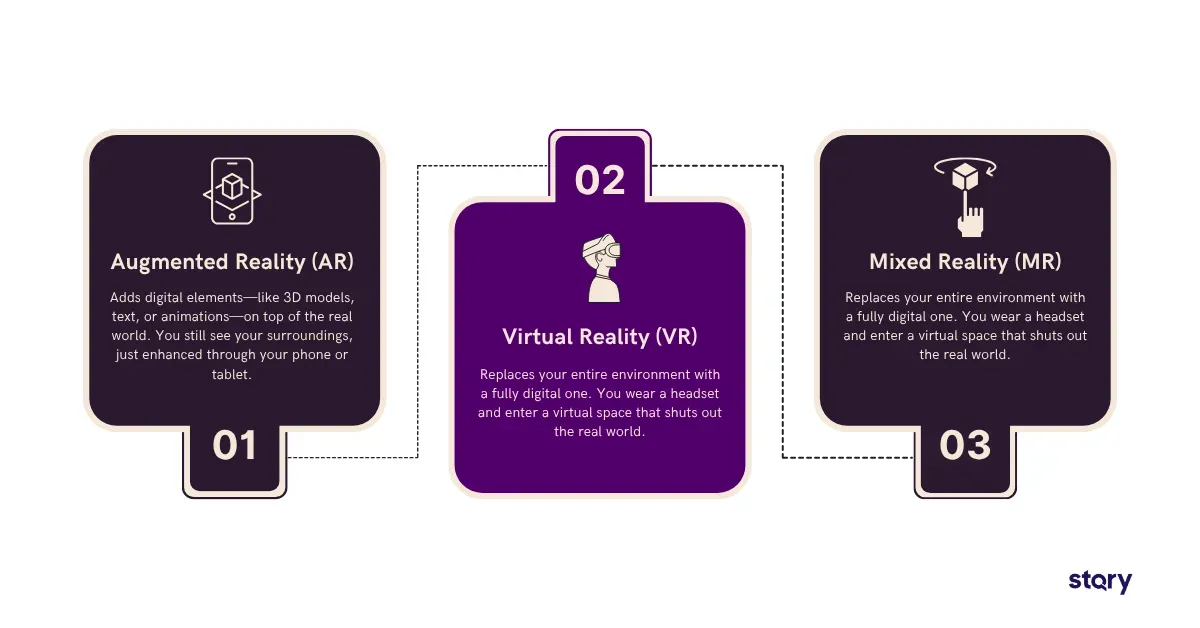
Augmented Reality (AR) overlays digital information such as images, 3D models, audio, and video onto the real world as you view it through a smartphone, tablet, AR glasses, or other compatible device.
The physical environment remains visible, while digital content appears layered over it.
Unlike AR, which adds digital content to the real world, Virtual Reality (VR) completely replaces your surroundings with a computer-generated environment.
Users typically experience VR through a headset that blocks out the physical world and immerses them in a virtual space.
Mixed Reality (MR) combines the real world with digital objects that can interact with their surroundings.
For example, a virtual robot could appear to stand on your floor, walk around furniture, and stay in the same spot even as you move around the room. It feels like the digital object is really there with you.
How does AR work at a heritage site?
When visitors explore a heritage trail, historic site, or cultural attraction, information can appear automatically as they move between locations. Many self-guided tour apps use geofencing to detect when a visitor enters a specific GPS-defined area.
When this happens, the app can trigger content automatically without requiring the visitor to scan a code or search for information.
Some apps also support location-based AR experiences. In these cases, digital content appears on the visitor's device and is layered over the real-world environment around them.
Indoors, AR experiences are often triggered using Bluetooth beacons, QR codes, or image markers. Beacons can detect when visitors are near a specific exhibit and automatically launch relevant content.
When a more deliberate interaction is preferred, visitors can scan a QR code or image marker to unlock the experience.
Once activated, the app can display 3D models in the live camera view and play audio that explains what visitors are seeing.
By combining visuals and storytelling, AR helps bring exhibits, artifacts, and historic sites to life.
Types of AR Heritage Experiences
Every historical site has a different story to tell, which is why AR experiences come in many forms. Here are five of the most effective types of AR experiences that help bring history to life.
1. 3D Reconstructions of Lost Structures
Some of history’s most important places no longer exist. Buildings have been destroyed, cities have disappeared, and landmarks have been lost over time.
Traditionally, the only way to convey what once stood in a particular spot was a flat illustration on a placard, asking visitors to do considerable imaginative heavy lifting. AR removes that burden completely.
Using GPS and 3D models, an app can recreate a lost structure at its original location. Visitors simply point their device at the site to see the building appear at its actual size and position. This helps them visualize the past more clearly.
2. Then-and-Now Photo Overlays
There is something powerful about placing the past and the present in the same view. With AR, a historical photograph can be aligned with the visitor’s current surroundings, so both scenes appear together on screen.
A busy harbour filled with tall ships can be shown over today’s marina, or a crowded 1890s street can appear over a quiet modern road. The comparison is immediate and easy to understand.
It works for all audiences because no prior historical knowledge is needed. Curiosity is enough.
3. Virtual Historical Figures as Guides
Facts about the past are easy to find, but the feeling of the past is harder to capture. Virtual historical figures help close that gap by turning history into first-person stories.
These characters are based on real people and speak directly to visitors about what they saw and experienced.
Instead of just reading facts, visitors hear the past in a more personal way, making the story easier to understand and more engaging.
4. Artifact Animation
A museum artifact behind glass can show what something looked like, but it often cannot explain how it was used. AR artifact animation helps bridge that gap.
When a visitor points their device at an object, a digital version appears on screen. It can rotate, assemble, and demonstrate how the artifact was held, worn, or used. This turns a static display into an interactive experience.
Instead of only seeing an object, visitors can understand how it functioned in real life and why it mattered in everyday use.
5. Multilingual Content Layers
Language is one of the biggest barriers in heritage interpretation, but it is often overlooked.
When visitors cannot understand the content at a site, they rarely have a meaningful experience. They may look around, take photos, and move on.
Multilingual AR helps solve this problem. It delivers the same GPS-triggered audio, 3D visuals, and historical narration in a visitor’s chosen language through a single app, without the need for extra staff or physical signage.
This improves accessibility and also helps sites reach and engage a wider audience.
Why AR at Heritage Sites Is Exploding
The global heritage tourism market was valued at $19.8 billion in 2024 and is expected to reach $45.6 billion by 2035, according to Future Market Insights. This growth is driven by rising cultural interest, increased international travel, and government investment in preserving historic sites.
In parallel, AR in the travel and tourism sector is expanding at a much faster pace. Market data shows it was valued at $20.33 billion in 2023 and is expected to reach $211.14 billion by 2031.
Within this, AR applications in museums and historical sites are also accelerating, with estimates placing the segment at $3.41 billion in 2024 and projecting continued high growth through the next decade.
Several factors are driving this growth at the same time. First, more people now carry AR-capable smartphones, making immersive experiences widely accessible.
On the institutional side, governments and cultural organizations, including UNESCO-related initiatives, are increasingly investing in digital interpretation and AR-based heritage projects.
At the same time, visitor expectations are evolving. They are shaped by everyday use of digital and mobile apps, where interactive and on-demand experiences have become the norm.
What are the Benefits of Augmented Reality at Historical Sites?
The enthusiasm around AR is not just hype. A growing body of peer-reviewed evidence shows measurable results across multiple dimensions.
1. Deeper Visitor Engagement and Dwell Time
Research found that AR technology in heritage museums directly fostered visitors' sense of temporal connection across time, which improves the overall visitor experience.
A separate study, based on 254 visitors at Liangzhu Museum using AR glasses, also found that novelty, trust in the technology, and perceived authenticity increase the likelihood of visitors wanting to use AR again and recommend it.
A systematic review by MIT Press, analysing peer-reviewed studies from 2015 to 2025, reinforced these findings, reporting 60% longer visitor dwell times and 20–35% higher knowledge retention compared to traditional displays.
Put simply: visitors who use AR stay longer, feel more connected, and come back — or tell someone else to.
2. Stronger Learning Outcomes
A study of an AR-guided tour at Cisneros Market Square in Medellín, Colombia found that participants who used the AR app showed significantly better cultural heritage learning outcomes than those who did not.
The AR group consistently demonstrated a deeper understanding of the site’s cultural and architectural significance.
This suggests that seeing information in context, rather than reading it on a sign, helps people understand and retain knowledge more effectively than passive interpretation alone.
3. Increased Accessibility
Language barriers are one of the most overlooked challenges in heritage interpretation. When visitors cannot understand the content, they often disengage and may leave early.
AR apps with multilingual content help solve this problem. They deliver the same experience in a visitor’s preferred language through a single platform. This removes the need for additional staff or physical signage.
Accessibility features like audio descriptions and text-to-speech can also be added, making the experience more inclusive.
4. New Revenue Streams
AR is not just an experience enhancer. It can also be a direct revenue driver.
Tiered content models allow organizations to offer free basic access while charging for premium digital content, immersive extras, or bundled ticket upgrades.
For many heritage operators, this turns an app from a cost center into a profit one.
5. Organic Social Amplification
One of AR's most underestimated benefits is what happens after the visit. Branded AR filters, shareable reconstructions, and visually striking "wow moments" naturally generate social media content.
Every photo or video a visitor shares introduces your site to hundreds of people who have never heard of it.
That kind of organic reach is something no advertising budget can fully replicate.
Case Study: How SA National Parks Used STQRY AR to Bring a Lost Building Back to Life
South Australia National Parks and Wildlife Service wanted visitors to connect with the history of Glenthorne National Park, including both colonial and Indigenous heritage.
However, the main landmark, Glenthorne House, was destroyed in 1932 and no longer exists.
Using the STQRY platform, they created the SA National Parks Tours app, a GPS-guided self-guided experience. The Glenthorne “Footprints from the Past” trail features six historical characters, including Kaurna Miyurna people, who share stories about the site.
A key AR feature lets visitors point their phone at the empty landscape to see a 3D reconstruction of Glenthorne House.
The project was recognized as a national finalist by Parks & Leisure Australia and showed how even small heritage organizations can use no-code tools to build advanced AR experiences without custom development.
FAQs
Where did AR originate?
Augmented reality traces its conceptual roots to the 1960s. In 1968, computer scientist Ivan Sutherland created the first head-mounted display, widely considered a precursor to AR and VR. The term “augmented reality” was later coined in 1992.
Who coined augmented reality?
The term “augmented reality” was coined in 1992 by Boeing researcher Tom Caudell. He used it to describe a system that displayed digital assembly instructions over the real world to help factory workers. The term helped distinguish the concept from virtual reality.
Is AR based on AI?
AR is not based on AI, but the two technologies work well together. AR overlays digital content onto the real world, while AI enhances it through features like object recognition, spatial mapping, and personalised content. Many modern AR systems use AI, but AR can function without it.
How is AR used in archaeology?
AR is used in archaeology to reconstruct excavated or destroyed sites in their original form. It overlays digital visualisations onto modern landscapes to show how a site once looked. It is also used to help researchers understand spatial relationships between artefacts and to let visitors experience historical environments.
What is an AR museum?
An AR museum is a museum or heritage site that uses augmented reality to enhance the visitor experience. It can include interactive exhibits where artefacts come to life or app-based tours with AR overlays. These experiences help bring spaces and stories to life for visitors.
Build Your AR Heritage Experience with STQRY
STQRY is a no-code platform designed for heritage organizations to create location-based storytelling experiences. It combines GPS-guided tours, AR overlays, multilingual audio, and gamification in one simple system.
Museums, parks, and cultural sites can use it to change how visitors experience history. Instead of static signs or traditional tours, visitors can unlock stories as they move through a space, view AR reconstructions, and access content in their own language.
The platform is easy to use, with no coding required. Teams can build and manage experiences themselves while still creating high-quality, immersive content across multiple sites.
STQRY also provides hands-on support, with a customer success team guiding organizations from setup through to launch and ongoing updates.
Ready to bring your historical site's stories back to life?