

According to the World Economic Forum’s 2025 report, global tourism could reach $16 trillion by 2034, with around 30 billion visits worldwide. UN Tourism also recorded 1.52 billion international arrivals in 2025, about 60 million more than the year before.
With numbers like these, competition between destinations is stronger than ever.
So what makes one place irresistible while another is overlooked entirely? The answer lies in a concept called tourist attractiveness.
This guide explains what that means, what influences it, how it’s measured, and how destinations can improve it.
What is Tourist Attractiveness?
Tourist attractiveness is the overall appeal a destination holds for potential visitors. It measures how desirable a place is based on a combination of factors. This includes its natural beauty, cultural depth, safety, infrastructure, affordability, and sustainability.
The stronger these elements are, the more attractive a destination is to travelers.
Think of tourist attractiveness as a scorecard that answers one core question: Why would someone choose this place over every other option available to them?
However, it's important to distinguish tourist attractiveness from a simple list of tourist attractions.
A famous landmark can draw a crowd once. Tourist attractiveness, however, is what makes a destination compelling enough to visit, recommend, and return to.
Academically, the concept of tourist attractiveness is grounded in what researchers call push and pull factor theory.
Push factors are the reasons people want to travel, like adventure, relaxation, or cultural experiences. Pull factors are what a destination offers, such as its scenery, culture, facilities, and hospitality.
Tourist attractiveness is how well what a place offers matches what travelers are looking for.
The 7 Core Factors of Tourist Attractiveness
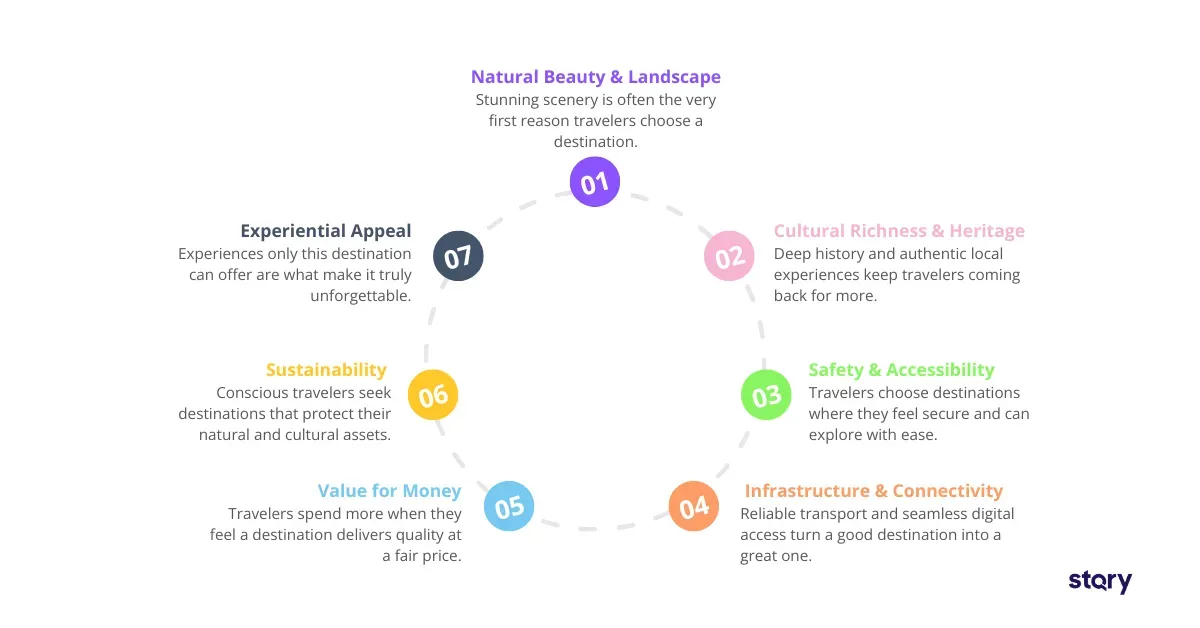
Research shows there are seven key factors that make a destination attractive. Each one matters, and together they shape how appealing a place is.
1. Natural Beauty & Landscape
Nothing attracts travelers more than natural beauty. Mountains, beaches, waterfalls, and wildlife all draw millions of visitors every year. Places like the Swiss Alps, the Great Barrier Reef, and the Serengeti stay popular because they offer unique experiences, not because of marketing.
Climate also plays a big role. Weather affects when and how people travel, and climate change is starting to influence those choices even more.
Many travelers now look for cooler destinations, a trend often called “coolcationing,” where people escape hotter regions for milder weather.
2. Cultural Richness & Heritage
Culture is one of the most powerful forces in travel decision-making. Research found that 66% of global travelers say they want authentic experiences that represent local communities and cultures.
Destinations that offer genuine cultural immersion consistently rank among the world's most visited.
UNESCO World Heritage Sites, ancient ruins, living museums, local festivals, and culinary traditions all contribute to a destination's cultural attractiveness.
Places like the pyramids of Egypt, the Colosseum in Rome, and Kyoto’s temple districts are more than attractions. They're windows into civilizations that no other place on earth can replicate.
3. Safety & Accessibility
A destination can be breathtaking and culturally rich, but if travelers don't feel safe or can't get there easily, the appeal drops sharply.
Safety is a top concern for travelers, especially families, solo female travelers, and people traveling internationally for the first time.
Accessibility is not just about physical safety. It also includes visa rules, how easy it is to get there, and the quality of transport like airports, roads, and public transit. All of these affect how easy a destination is to reach.
Increased air connectivity and enhanced visa facilitation were cited by cited by UN Tourism as key drivers of the record-breaking 2025 arrival figures. This is a clear signal that policy decisions directly affect tourist attractiveness.
4. Infrastructure & Connectivity
Good infrastructure is key to a good visitor experience. Even a beautiful place will struggle to attract or keep travelers if it has poor roads, few places to stay, or unreliable Wi-Fi.
The WEF's 2025 Travel & Tourism Development Index shows big differences in infrastructure between regions. Air transport infrastructure scores range from below 2 in some emerging economies to over 6 in developed markets like the UAE and the United States.
These gaps affect which destinations grow and which are left behind.
5. Value for Money
Travelers are more aware of costs than before. With tourism-related inflation running at 6.8% in 2025, more than double the pre-pandemic average of 3.1%, value for money now strongly influences travel decisions.
This doesn't mean travelers only seek cheap destinations. It means they're looking for places where quality experiences, accommodation, and dining are priced fairly relative to what they receive.
Destinations that deliver strong perceived value stand out in an increasingly competitive market.
6. Sustainability & Environmental Responsibility
Conscious travel is no longer a niche. A 2025 survey found that 84% of travelers say sustainability matters to them.
Moreover, the sustainable tourism market is expected to reach $8.43 trillion by 2033, growing at 17.3% per year, according to SkyQuest research.
Destinations that protect nature, support local communities, and reduce environmental impact are not only being responsible but also becoming more competitive.
7. Uniqueness & Experiential Appeal
Ultimately, what makes a destination truly magnetic is the feeling that you can't get this experience anywhere else.
A one-of-a-kind festival. An extraordinary natural wonder. A local food market tucked down a side street that isn't in any guidebook. These are the moments travelers remember and talk about for years.
More travelers now want immersive experiences instead of just seeing landmarks.
Destinations stand out when they offer something unique and tell their story in a clear and engaging way. This is what often turns a good trip into a memorable one.
How is tourist attractiveness measured?
Tourist attractiveness isn't just a feeling. It can be measured, compared, and tracked over time.
Several frameworks and indices exist to help governments, tourism boards, and researchers do exactly that.
The WEF Travel & Tourism Development Index (TTDI)
The most widely recognized benchmark is the World Economic Forum's Travel & Tourism Development Index, formerly known as the Travel & Tourism Competitiveness Index. It evaluates countries across three major sub-indexes:
- Regulatory Framework — covering safety, security, health, hygiene, and environmental sustainability
- Business Environment & Infrastructure — air transport, ground infrastructure, tourism services, and ICT readiness
- Human, Cultural & Natural Resources — workforce, cultural heritage, and natural assets
Countries are scored on a scale of 1 to 6, with aggregated scores forming an overall ranking that helps destinations identify where they lead and where they lag.
The Euromonitor Top 100 City Destinations Index
At the urban level, Euromonitor International's Top 100 City Destinations Index provides a holistic attractiveness score across six pillars:
- Economic and business activity
- Tourism performance
- Infrastructure
- Tourism policy and appeal
- Health and safety
- Sustainability
In 2025, the Index found that cities are focusing less on the number of visitors and more on attracting those who stay longer, spend more, and travel more responsibly.
Supply-Side vs. Demand-Side Approaches
Academic research approaches measurement from two angles. The supply-side looks at what a destination offers, including the number and quality of its attractions.
The demand-side focuses on how visitors feel about the place, including their perceptions and overall experience.
Research shows that destination attractiveness is the overall impression visitors form from all these factors. This perception influences their behavior, including whether they return and how responsibly they travel.
AI and Smart City Initiatives
AI and smart city development are becoming important for how attractive a destination is. According to Euromonitor’s 2025 report, cities that use AI well gain an edge in global competition.
These cities improve transport, support business innovation, and offer more personalized visitor experiences. Destinations that invest in smart tourism tools like real-time navigation and smarter traffic systems are climbing in popularity.
How Destinations Can Improve Their Tourist Attractiveness
Understanding tourist attractiveness is one thing. Acting on it is another. Here are six practical steps destinations and tourism marketers can take to strengthen their appeal.
1. Audit your destination's strengths
Start with an honest assessment. Which of the seven factors are strengths? Where are the gaps? A coastal destination might score highly on natural beauty but poorly on infrastructure.
A historic city might have deep cultural heritage but struggle with value for money. Identifying these gaps clearly allows for targeted investment
2. Invest in storytelling and digital marketing
Many destinations are more impressive than travelers realize. The issue is often not the place itself, but how it is presented.
Destinations that share authentic stories and create real cultural connections tend to stand out more.
Strong digital marketing, such as social media storytelling or virtual previews, can significantly change how a destination is perceived before visitors arrive.
3. Leverage local events, cultural festivals, and culinary tourism
Events and food experiences create the kind of memorable, shareable moments that no marketing budget can manufacture.
Oktoberfest in Munich, Diwali in India, Rio Carnival in Brazil. These cultural touchpoints have become international drawing cards in their own right.
Smaller destinations can replicate this on a local scale by investing in festivals, artisan markets, and food tours that showcase their unique identity.
4. Address infrastructure gaps
Smooth transport links, diverse accommodation options, and reliable digital connectivity are basic expectations for modern travelers.
Destinations that make it easy to arrive, move around, and stay tend to attract repeat visits.
Moreover, governments that simplify visa processes, improve airport facilities, and invest in connected public transport systems often see higher visitor numbers.
5. Build sustainability credentials
With three in five travelers planning to choose sustainable accommodation at least once in the next year, sustainability is becoming a key booking factor.
Destinations that show clear eco-friendly practices, support local communities, and follow responsible tourism policies are more likely to attract value-driven travelers.
6. Use tourism software and AI personalization
Digital tools are becoming a key way to improve tourist attractiveness, and they are now easier to access than ever.
Platforms like STQRY let destinations, museums, heritage sites, and parks create branded mobile tour apps without coding.
Visitors can use audio guides, GPS-triggered alerts, multilingual content, interactive quizzes, and offline maps directly on their phones.
For destinations wanting to improve visitor experience without building complex systems, this no-code approach offers a fast solution.
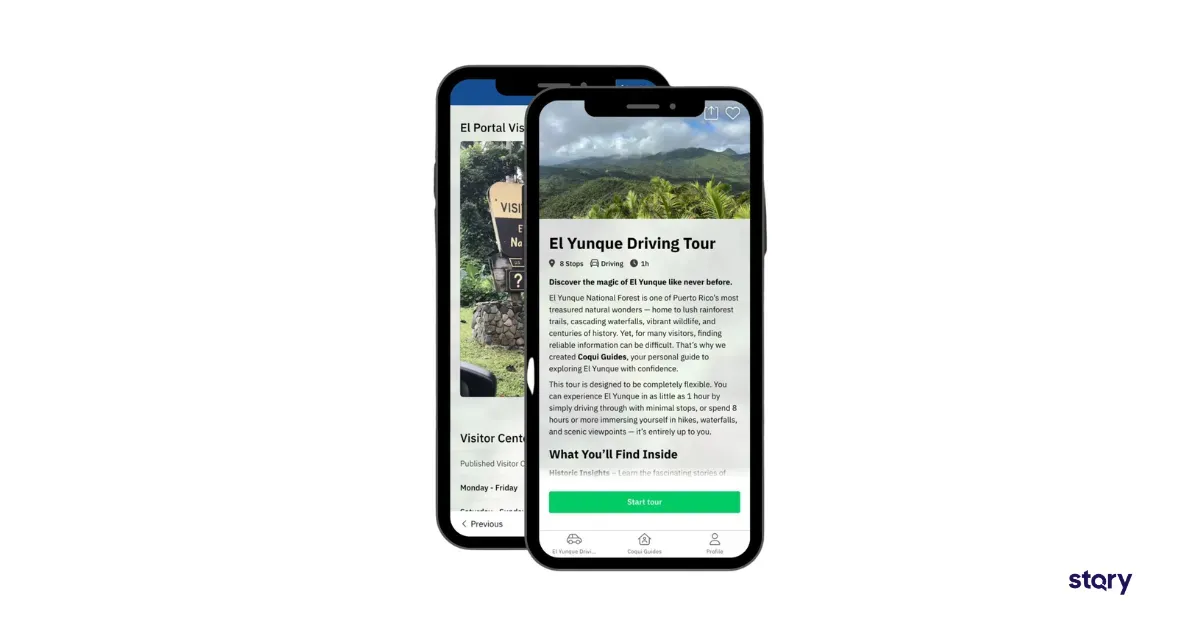
A good example is the El Yunque Driving Tour by Coquí Guides, powered by STQRY. It shows how digital tools can enhance a visit.
- Self-paced driving tour through El Yunque National Forest in Puerto Rico
- GPS stories and directions that activate along the route
- Offline access for areas with weak signal
- Discovery of waterfalls, wildlife, trails, viewpoints, and hidden spots
It turns a simple drive into a more immersive and memorable experience
What is the Future of Tourist Attractiveness?
The factors shaping tourist attractiveness are evolving fast. Here are the five trends every destination needs to watch.
1. Self-Guided Tours
A self-guided tour lets you explore a place at your own pace without a live guide. Instead of following a group, you use a mobile app or digital guide that provides stories, directions, and information as you go.
This format is popular because it combines structure with freedom. You get guided content while still choosing where to go, how long to stay, and what to skip.
Self-guided tours were once the domain of major museums and world-famous landmarks. Not anymore.
Today, STQRY has made it possible for any organization to build and publish professional self-guided tour experiences without writing a single line of code.
Visitors simply download the app or access it through a web browser, and the tour begins.
2. Augmented Reality
AR is transforming static heritage sites into interactive experiences. Visitors can point their phones at a ruin and see it reconstructed. They can walk through a museum and unlock hidden layers of context.
The SA National Parks Tours app, powered by STQRY, shows how this works in real life.
At Glenthorne National Park in South Australia, visitors can point their phones at an empty area and see a historic building appear through AR.
Glenthorne House, which once stood there before burning down in 1932, is digitally rebuilt on screen. Instead of just hearing about the past, visitors can actually see it.
This is what AR adds to the experience. It turns information into something visual and memorable that stays with visitors after they leave.
3. Accessible Digital Kiosks
Not every visitor arrives with a smartphone or a preloaded app. Children, older travelers, and international visitors still expect a rich, easy experience. Digital kiosks solve this gap.
A kiosk guides visitors, answers questions, and delivers interactive content on the spot. No app download, no setup, no staff needed.
STQRY Kiosk brings this experience to life in a simple, connected way. They work in museums, parks, heritage sites, and visitor centers, and offer flexible layouts, real-time updates, AR and 360° content, and multi-language accessibility.
It is also designed to be intuitive for first-time users while still powerful enough for complex storytelling.
For destinations already using STQRY mobile tours, the kiosk connects into the same system. That means the experience stays consistent, from the entrance display to the visitor’s mobile journey.
4. AI-Driven Travel Planning
AI is starting to change how people plan and experience travel. It can create personalized itineraries, adjust recommendations in real time, and help manage crowds at busy sites.
Destinations investing in AI tools and smart tourism systems can improve visitor experience and give them an advantage in a competitive market.
5. Overtourism Backlash
Perhaps the most significant shift reshaping tourist attractiveness is the growing recognition that more visitors isn't always better.
As Euromonitor's 2025 City Destinations Index makes clear, cities are now actively prioritizing "value over volume". They are focusing less on total visitor numbers and more on attracting travelers who stay longer and spend more.
The goal is also to encourage more responsible and meaningful tourism.
Enhance Your Tourism Attractiveness with STQRY
Tourist attractiveness is not fixed. It is something destinations build, improve, and maintain over time.
With the right digital tools, destinations can close gaps, improve the visitor experience, and tell their story in a more memorable way.
That's exactly what STQRY is built for. Whether you're creating self-guided tours, audio guides, AR experiences, or interactive kiosks, STQRY lets you build them all without any coding and deliver a world-class visitor experience.
Destinations that invest in digital storytelling today are the ones travelers will be talking about tomorrow.
Ready to become one of them?