

The smartphone is more than a way to stay in touch. For travelers, it serves as a booking tool, travel guide, and a way to enhance visitor experience.
Every stage of the journey, from the first search for a destination to the final post-trip review, now runs through a mobile screen.
If you are looking to understand the changes, this guide breaks down the mobile technologies that are reshaping the tourism industry.
Why Mobile Is the Backbone of Modern Tourism
Mobile-first booking platforms have replaced traditional travel agencies for the majority of travelers, with apps from OTAs, airlines, and hotels handling reservations, payments, and itinerary management in one place.
The pandemic accelerated this shift. Contactless check-ins, digital room keys, and app-based service were initially adopted as safety measures.
By 2026, they are standard expectations. Travelers who encounter properties without these features increasingly view them as outdated.
Mobile is also where travel inspiration begins. Social media, search engines, review platforms, and maps all converge on the smartphone.
By the time a traveler makes a booking decision, they have typically moved through multiple mobile touchpoints across several days or weeks.
Today, statistics show that 83% of travelers research trips on a mobile device before booking, and mobile devices generate 68% of all online travel traffic.
Key Mobile Technologies Transforming the Tourism Industry
From planning a trip to sharing it online, mobile technology influences every step. Below are the key technologies driving that transformation in 2026.
1. Mobile Booking and AI-Powered Trip Planning
App-based reservations now account for the majority of travel bookings. Travelers choose them for speed, clear pricing, and the ability to manage their whole trip in one place.
Beyond simple reservations, AI travel assistants are changing how itineraries are built. Platforms analyze a traveler's booking history, preferences, and behavior to generate personalized day-by-day plans in real time.
Building on this personalization, natural language search is replacing traditional form-based booking flows.
Instead of selecting dates from a dropdown, travelers can describe what they want conversationally. Then, the system extracts the relevant details.
Research shows that traveler use of generative AI for trip planning has risen sharply, with adoption increasing by 64%.
2. Self-Guided Tour Apps
Self-guided tour apps give travelers the flexibility to explore destinations independently, on their own schedule and at their own pace.
As visitors move through a location, audio, video, and text content can play automatically. This provides context and commentary without a human guide.
Outdoors, geofencing triggers content when someone enters a specific area. Indoors, Bluetooth beacons send signals to smartphones, which allows museums and heritage sites to deliver content for each room or exhibit.
Together, these technologies create a seamless, location-aware experience.
STQRY makes it easy for destination managers and cultural institutions to build branded mobile tour experiences. With our no-code platform, you don’t need a dedicated technical team to create branded mobile tour experiences.
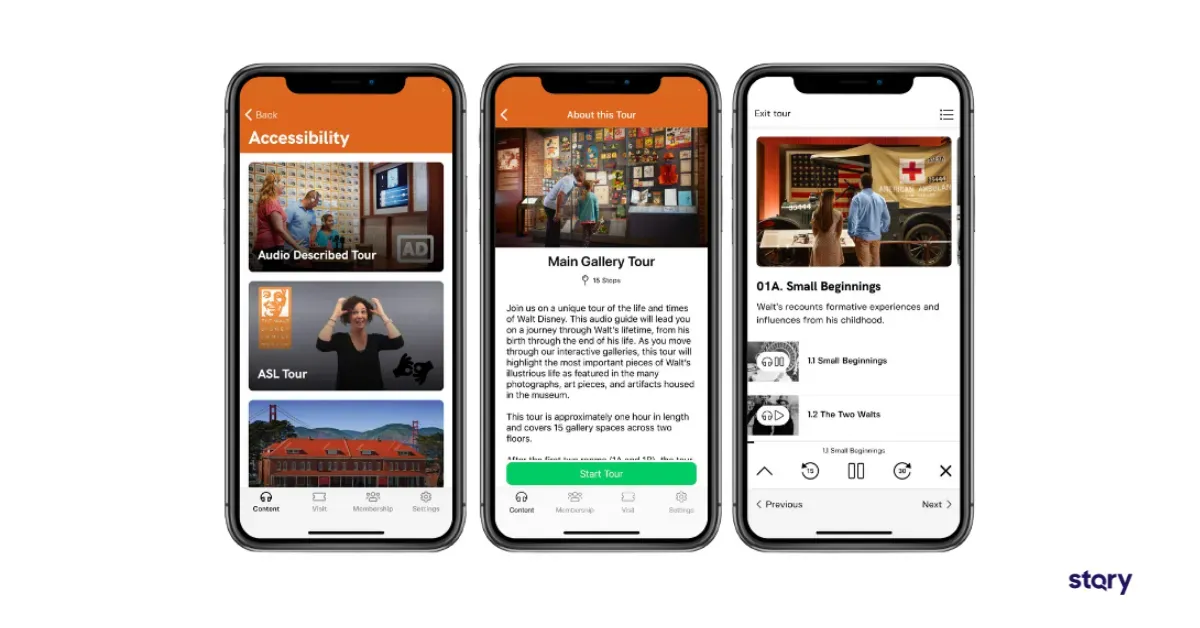
For example, the Walt Disney Family Museum created a self-guided tour app powered by STQRY Apps. The app was designed to address accessibility gaps across its galleries, focusing on non-English speaking visitors and guests with disabilities.
According to Tracie Timmer, Senior Public Programs Coordinator at the Walt Disney Family Museum:
"The goal of the project was to create an app to improve the accessibility of our galleries, particularly for non-English speakers and guests with disabilities."
For destinations looking to modernize the visitor experience, self-guided tour apps offer a practical, scalable starting point.
3. Augmented Reality (AR)
AR technology no longer requires specialized hardware. With today's smartphones, travelers can simply point their cameras at a point of interest and receive contextual information in real time.
Heritage sites and museums are applying this same approach to bring physical spaces to life, overlaying stories, timelines, and historical detail directly onto what visitors see in front of them.
A practical example of this is the SA National Parks Tours app, a self-guided mobile experience for South Australia's parks and heritage sites.
One of its AR features lets visitors view a 3D reconstruction of Glenthorne House, a historic property destroyed by fire in 1932.
Through the app, the building reappears on screen as it once stood, complete with the social history of the events it hosted.
It is a compelling illustration of how AR can recover and communicate stories that would otherwise be lost.
4. Virtual Reality and Immersive Pre-Trip Experiences
Virtual reality (VR) lets travelers preview destinations and accommodations before booking. Hotels, resorts, and tourism boards use 360-degree mobile VR to let prospective guests explore a property or destination from their phone.
VR also serves an accessibility function. Travelers with mobility challenges who may find certain destinations physically difficult to reach can experience them virtually.
After a trip, 360-degree video lets travelers relive and share their experiences in a more immersive way than regular photos.
5. Interactive Kiosks and Smart Touchpoints
Modern kiosks provide real-time wayfinding, attraction recommendations, and information in multiple languages, with accessibility features including audio output and adjustable text sizes.
In fact, research shows that over 55% of smart kiosk interactions are used for wayfinding or finding local information. This shows how visitors rely on them to navigate and explore a destination.
Moreover, kiosks are no longer separate from mobile phones. Visitors can simply scan a QR code on the display to transfer information directly to their smartphone for use on the go.
Data collected at kiosk interactions feeds into destination management systems, giving operators useful insight into visitor behavior and flow.
With STQRY Kiosk, museums, galleries, libraries, universities, and similar institutions can create interactive displays using text, video, images, and audio.
The platform supports accessibility, ensuring all visitors can enjoy the experience. It also brings exhibits to life by sharing their stories, offering interactive wayfinding, and providing engaging self-guided tours.
6. Mobile Payments and Contactless Commerce
Digital wallets have simplified transactions at every point of the travel journey. Statistics show that about 74% of travelers now view digital wallets as essential to their trip.
Many travelers also use these platforms for in-app purchases, such as upgrading tickets, booking tours, or accessing premium content. This makes the entire experience faster and more convenient.
Platforms like Apple Pay, Google Pay, and similar digital wallets allow travelers to pay for their experiences without handling cash or physical cards.
Blockchain technology is adding another layer of reliability to mobile payments in tourism. Smart contracts enable automatic refunds when cancellation conditions are met. This removes the delays and disputes that often accompany traditional refund processes.
7. Mobile Check-In, Registration, and Digital Waivers
Arrival is often one of the most stressful parts of a trip, but mobile technology is making it much smoother.
With mobile check-in, guests can register on their phones before they arrive. Instead of waiting in line, they get a confirmation and go straight to their experience.
Digital waivers also replace paper forms. Guests can review and sign them in advance, which speeds up entry and reduces crowding. It also keeps records stored safely online.
On top of that, mobile registration gives operators useful details ahead of time, like group size, preferences, or accessibility needs. This helps staff prepare a more personalized experience before guests even arrive.
8. Mobile Technology for Sustainable and Responsible Tourism
Sustainability is now an important factor in booking decisions, and mobile technology makes it easier for travelers and operators to make eco-friendly choices.
Features like digital tickets, QR-code tours, and paperless check-ins help reduce paper waste throughout the travel experience.
Cultural institutions are also digitizing collections and archives, making them accessible through mobile apps and reducing pressure on physical sites.
so able to focus on curating and expanding content instead of managing technical issues.
9. Global Connectivity and eSIM Technology
Every mobile technology in tourism relies on a reliable internet connection. eSIM platforms like Airalo make this easier by letting travelers activate local data plans instantly. They work in over 200 destinations and remove the need to swap physical SIM cards.
At the infrastructure level, 5G networks support high-bandwidth experiences such as real-time AR, IoT integration, and fast bookings.
In remote destinations, satellite internet services like Starlink extend mobile connectivity to lodges, eco-resorts, and off-grid attractions.
Elevate Visitor Experiences with STQRY
STQRY is your partner in engaging today's travelers. STQRY helps organizations of all kinds create engaging, interactive, and accessible digital experiences.
Whether you want to build self-guided tours, interactive kiosks, or digitize your collections, STQRY makes it simple and flexible.
Our excellent customer success team also ensures you get the support you need to bring your vision to life.
Ready to future-proof your tourism business with mobile technology?